Running with klekoty in Bukówiec Górny
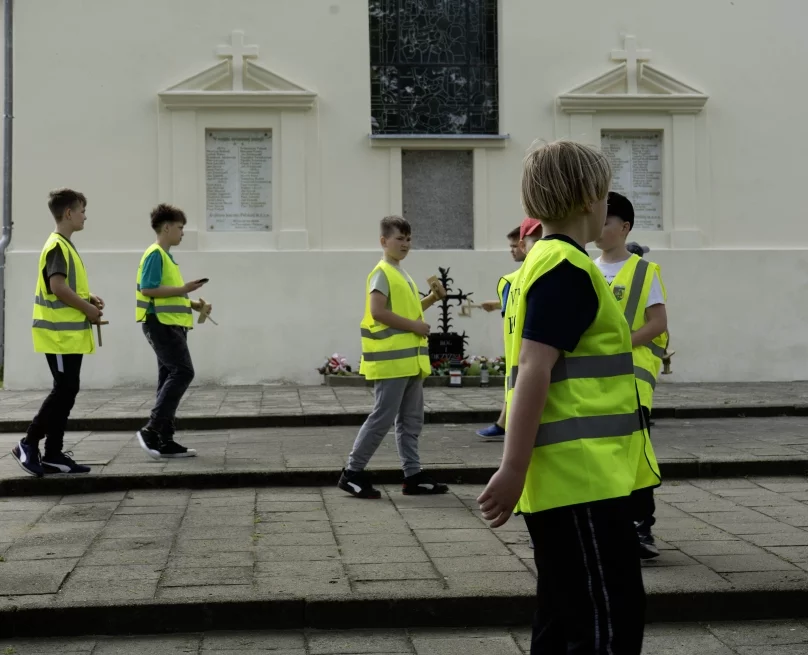
Running with klekoty takes place on Good Friday and Holy Saturday, three times a day at the church bells' ringing times: morning, noon, and evening. Participants are divided into two teams, depending on their place of residence: the Great End or the Little End of Bukówiec Górny.
The main props are wooden clappers, or hammer clappers, and two wheelbarrows, "Old Man" and "Old Woman," each with a single wheel and handles. Running with klekoty is a relay race, with team members taking turns passing the wheelbarrow. They begin and finish the race by laps around the church. One team then runs along the main street to either end. Traditionally, runners complete laps by the chapels along the route. Six runs over two days count towards the overall score.
During this year's running with klekoty, on Good Friday morning in Bukówiec Górny, the atmosphere of preparations for the upcoming Easter was palpable, with final cleanups underway. Boys of all ages, some of them altar boys, slowly gathered at St. Martin's Church. Mandatory equipment for each participant included a yellow reflective vest with the words "Wielki or Mały Koniec" (Great End) and a wooden klekot, a hammer-shaped clapper that produces a loud, knocking sound, which was eagerly displayed.
The older boys retrieved wheeled "wheelbarrows" from the bell tower, which had been used here for generations, and divided them between the two teams. At 12:00 noon sharp, the second of six races began. The first phase, shared by both teams, consisted of laps around the church, a descent down the steps leading to the church, and a drive through the gate. Then the teams turned left or right and sped down the main street (Powstańców Wielkopolskich) to one end or the other of the village. During the wheelbarrow race, the boys completed mandatory laps of the chapels they passed along the way. The race was a relay race, so individual team members passed the wheelbarrow to each other, while the rest stood nearby, making noise with their klekoty. After returning to the church, the teams circled it three more times.
This time, Mały Koniec (Little End) was victorious. As the klekotnicy explained after their flight: "Usually Wielki Koniec wins; last year they dominated 6-0. [And today?] This year, they're not doing so well. We decided to give them a head start because they don't win often enough. All six races count, three each on Good Friday and Saturday (the boys after running with klekoty)."
The boys agreed that running with klekoty is a fun tradition, one they eagerly participate in, following in the footsteps of their older brothers and friends. After a moment of rest and a lively exchange of impressions, they stowed their wheelbarrows in the bell tower and headed home to regain their strength for the next round.
No, it wasn't about who would win, it was about all the residents simply hearing that the bells weren't ringing, but instead those klekoty sounds, the traditional ones – Good Friday and Holy Saturday, morning, noon, and evening. (resident of Bukówiec Górny)
Residents recall that in the past, when there wasn't much traffic on the main street, the klekotnicy would run in a group down the middle of the road. Older boys watching would often join in to support their team. There were arguments between groups and mutual accusations of failing to follow the established rules. The most favorable outcome was to finish at a similar time and decide the race by circling the church three times.
You run to both ends; there were always two groups. And if there were only a few participants, one group, we could even run to both sides of the church. It even happened that way. It simply depends on how many boys were there. (Resident of Bukówiec Górny)
Who made klekoty?
They made klekoty before me. There were a few carpenters in Bukówiec, many of them switched to wooden toys before Christmas, some rocking horses, and they were the ones who made klekoty as needed. My parents and grandfather often made them. They were of various kinds, nicely made and more crude, but the goal was the same: they had to do their job and they had to rattle. In my klekoty collection, I have a neighbor's rattle from 1934, and it still works. The secret is that it's made of hardwood. […] Sometimes the boys come running with their klekoty, something breaks, something happens, and if it rattles well, it's fine. That's when I regenerate and they keep running. (Jerzy Sowijak)
The main props are wooden clappers, or hammer clappers, and two wheelbarrows, "Old Man" and "Old Woman," each with a single wheel and handles. Running with klekoty is a relay race, with team members taking turns passing the wheelbarrow. They begin and finish the race by laps around the church. One team then runs along the main street to either end. Traditionally, runners complete laps by the chapels along the route. Six runs over two days count towards the overall score.
During this year's running with klekoty, on Good Friday morning in Bukówiec Górny, the atmosphere of preparations for the upcoming Easter was palpable, with final cleanups underway. Boys of all ages, some of them altar boys, slowly gathered at St. Martin's Church. Mandatory equipment for each participant included a yellow reflective vest with the words "Wielki or Mały Koniec" (Great End) and a wooden klekot, a hammer-shaped clapper that produces a loud, knocking sound, which was eagerly displayed.
The older boys retrieved wheeled "wheelbarrows" from the bell tower, which had been used here for generations, and divided them between the two teams. At 12:00 noon sharp, the second of six races began. The first phase, shared by both teams, consisted of laps around the church, a descent down the steps leading to the church, and a drive through the gate. Then the teams turned left or right and sped down the main street (Powstańców Wielkopolskich) to one end or the other of the village. During the wheelbarrow race, the boys completed mandatory laps of the chapels they passed along the way. The race was a relay race, so individual team members passed the wheelbarrow to each other, while the rest stood nearby, making noise with their klekoty. After returning to the church, the teams circled it three more times.
This time, Mały Koniec (Little End) was victorious. As the klekotnicy explained after their flight: "Usually Wielki Koniec wins; last year they dominated 6-0. [And today?] This year, they're not doing so well. We decided to give them a head start because they don't win often enough. All six races count, three each on Good Friday and Saturday (the boys after running with klekoty)."
The boys agreed that running with klekoty is a fun tradition, one they eagerly participate in, following in the footsteps of their older brothers and friends. After a moment of rest and a lively exchange of impressions, they stowed their wheelbarrows in the bell tower and headed home to regain their strength for the next round.
No, it wasn't about who would win, it was about all the residents simply hearing that the bells weren't ringing, but instead those klekoty sounds, the traditional ones – Good Friday and Holy Saturday, morning, noon, and evening. (resident of Bukówiec Górny)
Residents recall that in the past, when there wasn't much traffic on the main street, the klekotnicy would run in a group down the middle of the road. Older boys watching would often join in to support their team. There were arguments between groups and mutual accusations of failing to follow the established rules. The most favorable outcome was to finish at a similar time and decide the race by circling the church three times.
You run to both ends; there were always two groups. And if there were only a few participants, one group, we could even run to both sides of the church. It even happened that way. It simply depends on how many boys were there. (Resident of Bukówiec Górny)
Who made klekoty?
They made klekoty before me. There were a few carpenters in Bukówiec, many of them switched to wooden toys before Christmas, some rocking horses, and they were the ones who made klekoty as needed. My parents and grandfather often made them. They were of various kinds, nicely made and more crude, but the goal was the same: they had to do their job and they had to rattle. In my klekoty collection, I have a neighbor's rattle from 1934, and it still works. The secret is that it's made of hardwood. […] Sometimes the boys come running with their klekoty, something breaks, something happens, and if it rattles well, it's fine. That's when I regenerate and they keep running. (Jerzy Sowijak)